If you’ve ever watched your dog tense up at the sight of nail clippers or flatten their ears when the vet reaches for them, you’re not alone. Many dogs find routine husbandry and veterinary procedures stressful, and for some, that stress becomes fear, avoidance, or even aggression.
But there’s a better way.
Cooperative care is transforming how we support dogs through healthcare. Instead of relying on restraint or hoping they “just cope,” cooperative care teaches dogs to actively participate in their own care. It gives them predictability, choice, and a voice.
And when dogs feel safe and understood, everything changes.
What Is Cooperative Care?
Cooperative care is a training approach that helps dogs calmly and willingly engage in grooming, handling, and veterinary procedures. It’s built on three core ideas:
- Clear communication Dogs learn specific behaviours that signal “I’m ready.”
- Predictability Procedures are broken into small, understandable steps.
- Agency Dogs are allowed to pause or opt out without punishment.
This isn’t permissive or chaotic. It’s structured, evidence‑based behavioural medicine that reduces fear and increases safety.
Teaching Dogs to Say “Yes” and “No”
One of the most powerful parts of cooperative care is teaching dogs to communicate clearly. Instead of guessing how they feel, we train deliberate behaviours that act like “yes” and “no.”
The “Yes” Behaviour
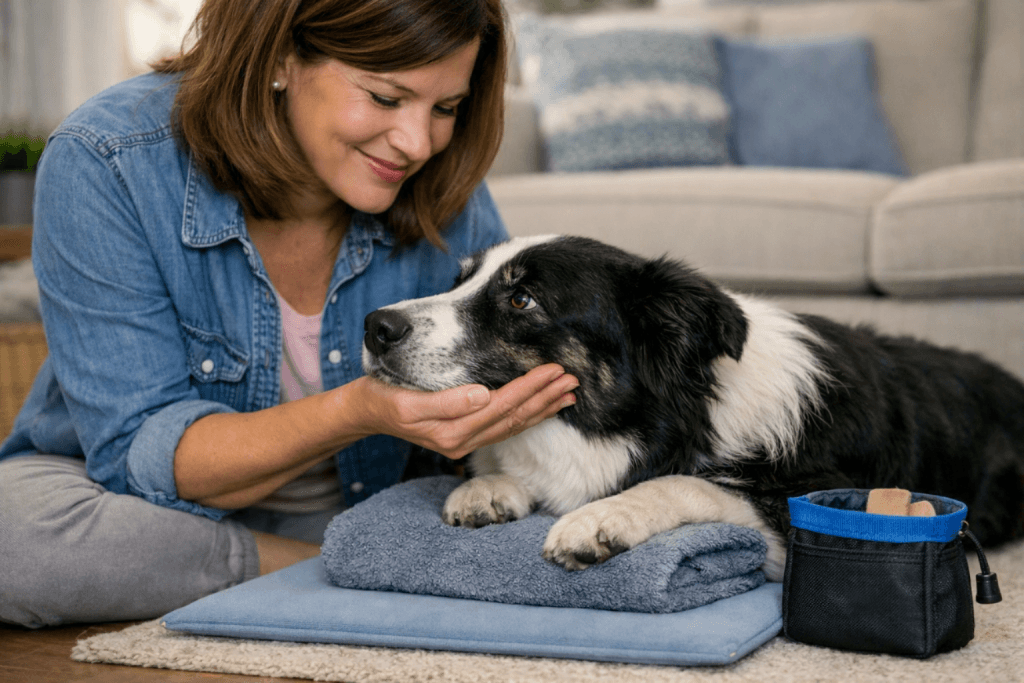
A “yes” behaviour is a trained action that tells us the dog is ready to begin.
Common examples include:
- Resting their chin on a towel or the vet’s hand
- Stepping onto a mat
- Targeting a hand or object
- Standing still at a designated station
When the dog offers the behaviour, the procedure begins. If the behaviour stops, the procedure pauses.
This simple rule builds enormous trust.
The “No” Behaviour
A “no” behaviour is just as important. It’s a calm, trained action that means “I need a break.”
Examples include:
- Moving off the mat
- Lifting their chin away
- Turning their head from the equipment
- Stepping back from the station
The key is that “no” doesn’t end the session—it simply pauses it. The dog learns that communication works, and that reduces the need for escalation.
Over time, dogs become more confident, more relaxed, and more willing to participate.
Start Button Behaviours: The Dog’s Way of Saying “I’m Ready”
A start button is a specific behaviour the dog uses to initiate a procedure. It’s the clearest form of “yes.”
Examples include:
- Offering a paw for nail care
- Placing their chin on a platform for an ear exam
- Targeting a hand to begin an injection
- Stepping into a harness for blood pressure measurement
How It Works
- The dog performs the start button behaviour.
- The procedure begins.
- If the dog stops the behaviour, the procedure pauses.
- When ready, the dog re-offers the start button.
This creates a rhythm of consent-like communication that keeps arousal low and cooperation high.
Why Start Buttons Matter
- They reduce anticipatory anxiety.
- They make procedures predictable.
- They allow gradual desensitisation without overwhelming the dog.
- They give the dog a sense of control, which is a major protective factor against fear.
- They improve safety for vets, nurses, and guardians.
Start buttons aren’t tricks—they’re clinical tools that support behavioural medicine and reduce the need for restraint or sedation.
Real-Life Applications in the Clinic
Cooperative care can be used for almost any procedure:
- Nail trims
- Blood draws
- Injections
- Muzzle training
- Grooming
- Ear and eye exams
- Dental checks
- Harnessing and weighing
- Physiotherapy
- Medication administration
For dogs with behavioural disorders, cooperative care becomes part of the treatment plan. It supports desensitisation, reduces avoidance, and builds resilience.
Why Cooperative Care Matters
Fear in veterinary settings isn’t just unpleasant—it affects learning, increases cortisol, and can worsen behavioural conditions. It also increases risk for staff and guardians.
Cooperative care:
- Enhances welfare
- Improves safety
- Reduces restraint
- Builds trust
- Supports long-term behavioural stability
- Makes vet visits kinder and calmer
It reframes veterinary care from something done to the dog into something done with the dog.
The Future of Veterinary Behavioural Medicine
As cooperative care becomes more widely adopted, we’re seeing:
- Fewer fear-based reactions
- More successful low-stress handling
- Better compliance with medical treatment
- Stronger human–animal relationships
- Improved welfare for anxious or previously traumatised dogs
Teaching dogs to say “yes” and “no,” and using start buttons, is humane, modern, and deeply aligned with what we now understand about animal welfare and learning.
Cooperative care isn’t just a training method—it’s a philosophy of kindness, clarity, and respect.