A guide for dog owners who dread the nail trim as much as their dog does
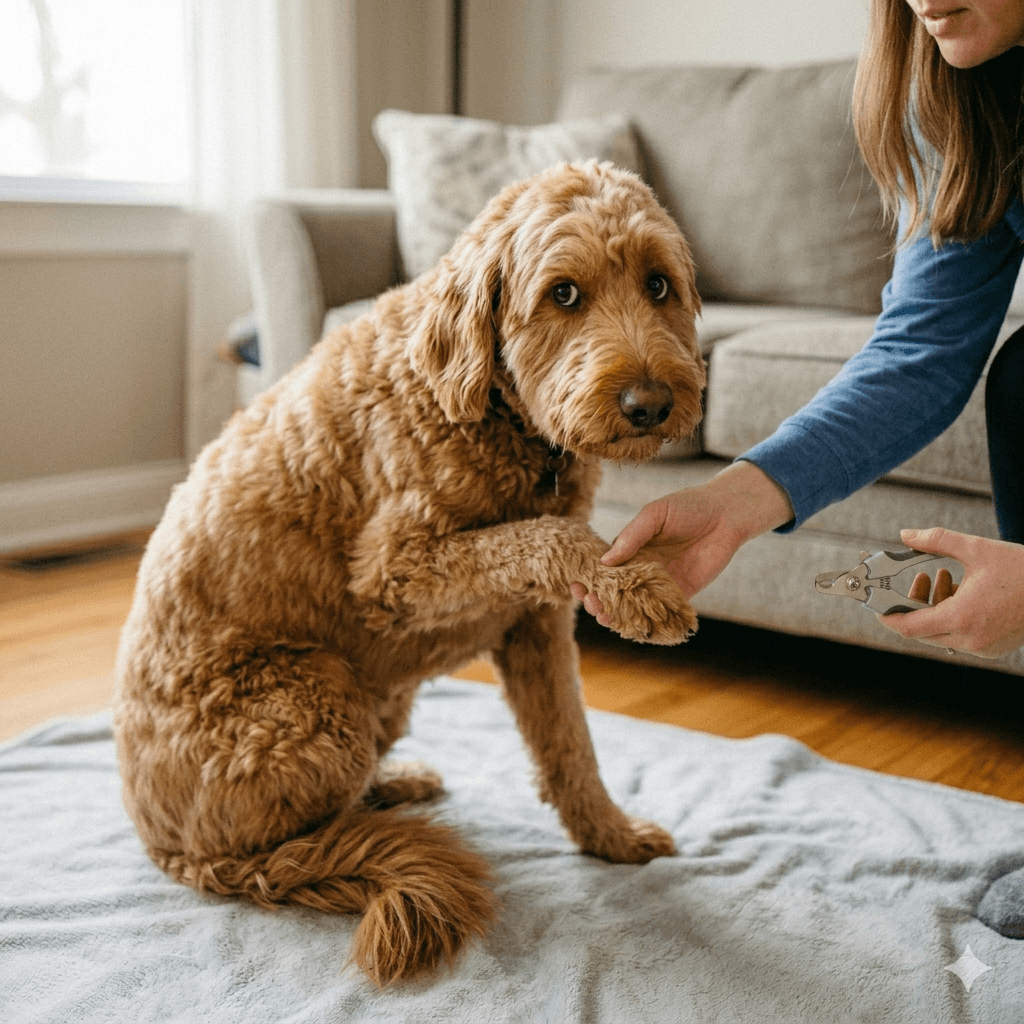
If you’ve ever tried to trim your dog’s nails and ended up with a wriggling, growling, or cowering animal — you’re in very good company. Nail trims are one of the most commonly dreaded grooming tasks in veterinary and home care settings alike. But here’s the thing: your dog isn’t being difficult on purpose. There’s real science behind their reaction, and real solutions that go far beyond “just hold them still.”
Anatomy of the Problem
Before we talk behaviour, it helps to understand what’s actually happening physically.
Each dog nail contains a quick — a bundle of blood vessels and nerves that runs through the centre of the nail. In dogs with light-coloured nails, you can see it as a pink line. In dark nails, it’s invisible, which is part of what makes trimming so tricky.
The quick is sensitive. Even the pressure of the clipper before the cut can cause discomfort, especially in dogs whose nails have grown long (the quick grows with the nail). And if the quick has ever been accidentally cut — which happens to almost every dog owner at some point — the resulting pain and bleeding creates a powerful memory.
Dogs also have highly sensitive paws in general. Their paw pads are rich in nerve endings, and many dogs simply dislike having their feet touched at all, regardless of what tool is involved.
Why One Bad Experience Can Last Years
Dogs are extraordinarily good at learning through association — it’s one of their greatest survival tools. When something frightening or painful happens, the brain tags everything present in that moment as a potential threat: the clippers, the smell of the room, the position of being held down, even the look on your face.
This is called fear conditioning, and it can happen after a single unpleasant event.
What makes nail trims particularly challenging is that they hit several stress triggers at once:
- Physical restraint — being held or pinned triggers a “trapped” response in many dogs
- Unfamiliar tools — clippers make an unusual sound and create pressure before the cut
- Paw handling — an already sensitive area being grabbed suddenly
- Looming body posture — humans leaning over dogs can be perceived as threatening
- Unpredictability — the dog has no way to signal “stop” or “I need a moment”
Over time, the anticipation of the nail trim becomes its own stressor. You may notice your dog begins to show signs of anxiety the moment the clippers come out of the drawer — or even when you simply walk toward the grooming area.
Reading the Signs: What Does Stress Actually Look Like?
Many owners interpret their dog’s behaviour during nail trims as stubbornness or dominance. In reality, it’s almost always fear or discomfort. Signs to watch for include:
- Pulling the paw away repeatedly
- Yawning, lip licking, or turning the head away (calming signals)
- Panting or drooling
- Trembling or a tucked tail
- Freezing
- Growling, snapping, or biting
- Trying to escape or hide before you’ve even begun
None of these behaviours mean your dog is “bad.” They mean your dog is communicating — and it’s worth listening.
The Solutions: Building a Better Nail Trim Experience
The good news is that with patience and the right approach, most dogs can learn to tolerate — and some even to accept — nail trims calmly. Here’s where to start.
1. Desensitisation and Counter-Conditioning
This is the gold standard for fear-based nail trim aversion, and it works by slowly changing your dog’s emotional response to the tools and process.
The key principles are:
- Go at your dog’s pace, not yours. There is no rush.
- Keep sessions short — even 30 seconds counts.
- Use high-value rewards — think real chicken, cheese, or whatever makes your dog’s eyes light up.
- Never push past the threshold where your dog shows stress.
Start by simply placing the clippers on the floor and rewarding your dog for sniffing them. Then pick them up and reward. Then touch the clippers to a paw. Then apply gentle pressure. Each step may take days, weeks or months — and that’s completely normal.
2. Cooperative Care
Cooperative care is a training philosophy that gives dogs agency in their own handling. Rather than restraining your dog and pushing through, you teach them to voluntarily participate and to signal when they need a break.
Common techniques include:
- Chin rest — the dog rests their chin in your hand as a “green light” signal. When they lift their chin, you stop.
- Stationing — teaching the dog to stand or lie in a specific position during grooming
- The bucket game — the dog focuses on a treat-filled container; when they look away, you pause
These techniques sound simple, but they create profound shifts in how dogs experience veterinary and grooming care. Dogs who feel in control are significantly less anxious — and much safer to handle.
3. Rethink Your Tools
For many dogs, nail grinders (rotary tools) are far better tolerated than traditional clippers. Here’s why:
- No sudden “snap” pressure
- Gradual removal of nail material rather than a single cut
- Lower risk of catching the quick unexpectedly
- Can be done in very small increments
The trade-off is noise and vibration, which some dogs dislike — but these can be desensitised just as clippers can. There are also quiet, low-vibration models specifically designed for anxious pets.
4. Change the Positioning
Many dogs do better when the nail trim doesn’t involve being loomed over or placed on a table. Options worth trying:
- Sitting beside your dog on the floor rather than above them
- Trimming from behind — some dogs are calmer when they can’t see the clippers directly
- The “over the shoulder” technique — lying your dog on their back in your lap
- Using a lick mat smeared with peanut butter or wet food as a distraction during the trim
Find the position your individual dog finds least threatening — there’s no single right answer.
5. Little and Often Beats Marathon Sessions
Trying to do all four paws in one sitting is often what breaks the experience down. Instead:
- One nail a day is a completely valid goal
- Short, positive sessions reinforce that nail trims = good things
- Over time, you build a positive history that begins to outweigh the old, negative one
6. Keep the Nails Short to Begin With
When nails are kept regularly trimmed, the quick recedes over time, making future trims easier and less risky. Letting nails grow long means a longer quick, more sensitivity, and a greater chance of accidental cuts — which perpetuates the fear cycle.
If nails are already very long, your vet can advise on a gradual shortening plan, sometimes over several weeks.
When to Seek Professional Help
If your dog’s fear or reactivity around nail trims is severe — particularly if there is biting, intense panic, or the stress is affecting their daily quality of life — it’s worth involving a professional.
Consider reaching out to:
- Your veterinarian — to rule out pain as an underlying factor, and to discuss whether short-term anxiolytic medication might help “take the edge off” while you work on training
- A Fear Free® certified veterinary professional or groomer — trained specifically in low-stress handling techniques
- A certified veterinary behaviourist — for complex or longstanding fear responses
There is no shame in asking for help. In fact, getting the right support early prevents the problem from becoming more entrenched over time.
A Final Thought
Nail trims don’t have to be a battle. With the right understanding of how dogs learn and what they find frightening — and a willingness to slow down and work with your dog rather than against them — it’s possible to transform one of the most stressful grooming tasks into something genuinely manageable.
Your dog isn’t trying to make your life difficult. They’re just asking to feel safe. And that’s something we can absolutely help with.
Have questions about nail trims, cooperative care, or low-stress handling for your pet? Get in touch with our team — we’d love to help.